
2015-11-01

2015-10-25
Hello SUSE!
Today I logged on to SUSE Linux for the first time!
First I had to install a vnc server. I logged on with the help of putty and fired up yast in tty mode.

I installed tigerVnc, with yast it was a breeze.
Then I ‘vnc logged into’ SUSE, since it has a KDE gui I felt at home right away.
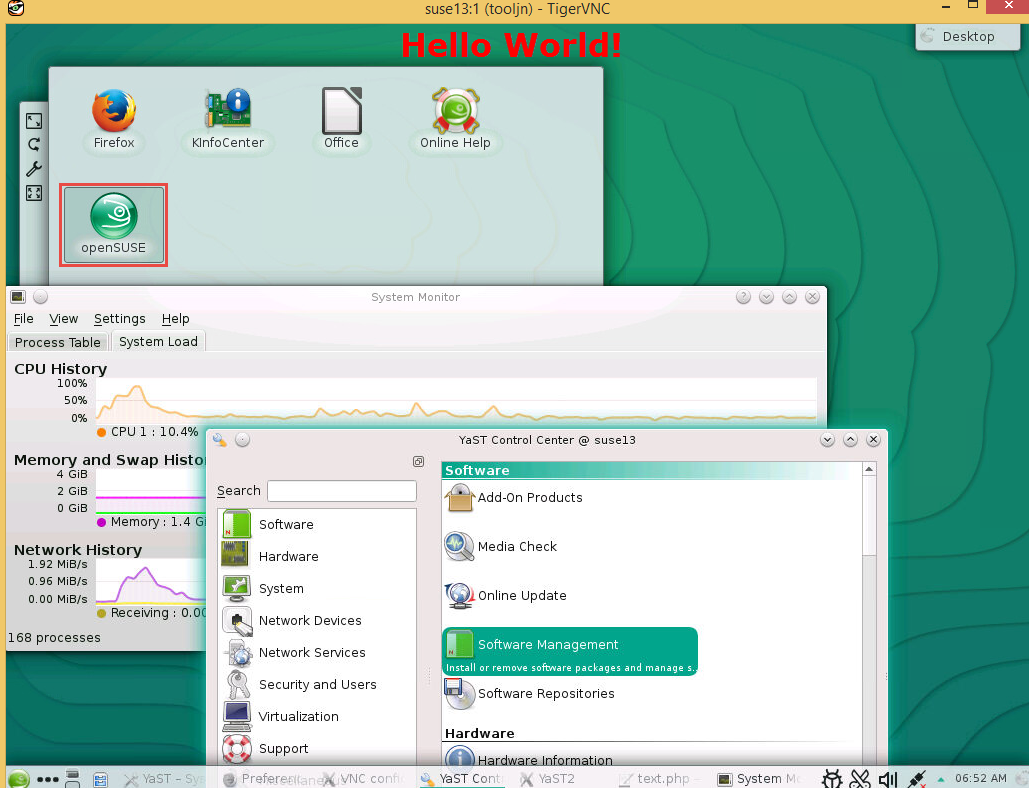
Now I ‘only’ have to create an ETL server for the Data Warehouse, this will take some time, since I have to do this in my spare time, it is sort of a hobby to me, I do IT architecture during work hours. I will blog about my progress.
2015-10-22
Data Warehouse upgrade
After procrastinated a general upgrade of the Data Warehouse for a long time we now have gone from Ubuntu 12.04 to 14.04. To my great surprise this upgrade seems to have worked well. We also painlessly upgraded MySql from version 5.5 to 5.6. We tried MySql 5.7 but found a number of incompatibilities, so we decided to wait with MySql 5.7 until we have ironed out any problem. We had a moment when we thought we had kissed the japanese DW satellite goodbye, after upgrading the server we restarted the server but it didn’t came up again. We had to wait for the guys in Japan to push the power button. But on the whole it was a smooth transition, about ten or so upgraded servers without any major issues.
After the upgraded Data Warehouse landscape have stabilized, we will also try to move our ETL server from Mageia to SUSE Linux. The Data Warehouse started on Mandrake Linux 2001 and continued on Mandriva and lately on Mageia. These Linux distros have served us well but now we will try SUSE not only for the hell of it, SUSE has a partnership with SAP and that might make the Data Warehouse more acceptable in the company. The sad story is nobody in the company knows what Mageia Linux is which makes the Data Warehouse kind of an oddball. SUSE Linux is more digestible for the IT community in the company. But we will try openSUSE not SUSE Linux Enterprise, after all the Data Warehouse was not formed after the standard enterprise model.
2015-09-21
Curl and sharepoint authentication
Our sharepoint uses NTLM for authentication, it took me some
time to figure that out. I access a sharepoint site from our Linux Data Warehouse environment
using curl. Seems like curl can handle NTLM, but this is what curl says about
NTLM.
The NTLM
authentication method was designed by Microsoft and is used by IIS web servers.
It is a proprietary protocol, reverse-engineered by clever people and
implemented in curl based on their efforts. This kind of behavior should not be
endorsed, you should encourage everyone who uses NTLM to switch to a public and
documented authentication method instead, such as Digest.
curl --ntlm -u userid http://sharepointServer/thePathTo/Items
2015-09-13
Big O

Recently I came across something that reminded me of my youth, big-O calculations. Big-O is used to calculate the complexity of algorithms or programs, big-O gives you a rough worst case estimation of the performance of an algorithm, and how runtime and space grows relative to the size of the input.
I didn’t know anything at all about big-O, but replied ‘do anyone really do that kind of calculation?’, when I was asked about big-O. It reminds me of the time when people tried to estimate run times of programs by calculating revolving speed of drum memories and the time of machine instructions etc. When I started work with computers people had just stopped doing that type of calculations, and I was very happy for that.
I was told big-O is a big thing, it gives a worst time measurement of the algorithm the higher big-O figure the likelier it will run slower. But there is so many ifs and buts, these days you cannot do proper run time calculations just by evaluating the source code, you need to understand the program optimizer, high level instructions, libraries, hardware, opsys. If you have a program language good at e.g. parallel optimize your code with a JIT compiler that may skew your calculations, if I got big-O right.
I have checked with some younger colleagues, one said when I asked, ‘I recall this from school, but I never used it in real life, real runtime figures are dependent on so many other things, I can image it can be of use for assembler or C programmers, but for modern high level programming languages it is probably of limited use’. The others I asked did not know what big-O was, one said he remembered something about calculating runtime of programs.
With my limited knowledge, I see big-O as a simple and clever option to programmatically compare different program snippets. This can come handy if you are developing a program language optimizer or a JIT compiler, but otherwise it is of little use. Big-O is an interesting subject and gives food for thought. I would not be surprised if I will use big-O one of these days.
I have spent years of optimizing computer systems, anything from network throughput to assembler algorithms, SQL queries, physical IO of databases etc, etc. I ‘only’ used real measurement, which you can rely on since they are real.
Links I found useful when I studied big-O:
http://discrete.gr/complexity/
https://www.interviewcake.com/article/big-o-notation-time-and-space-complexity
http://bigocheatsheet.com/
2015-09-02
Summer's (almost) gone
Summer ended 1st September 2015 here in Stockholm. We had a fantastic summerly August which is rare here, most years summer is over in mid August, but not this year.

Autumn view from the office 2nd September, rainy but still warm.
I spent some time this August getting acquainted with MS SQL Server, it was an unexpected pleasant experience. Last time I looked at SQL Server was 2001 and at that time I disregarded the software as a toy not fit for serious work. That is not true anymore, it looks like a good serious database manager. I have to spend a lot more time with the database to really understand SQL Server, but it was a breeze to create a database with constraints, indexes and all that. The management studio is a nice development environment. Transact-SQL will probably take a long time to master. On the whole SQL server is the same as other mature relational database managers, but different (they all are :-).
While working with SQL server I realised I miss DBA work, real proper DBA work, designing database, fixing performance problems, helping developers with tricky SQL queries. Not only installing the software and running utilities. I have to do something about this :-)
2015-08-09
The DW satellite is down
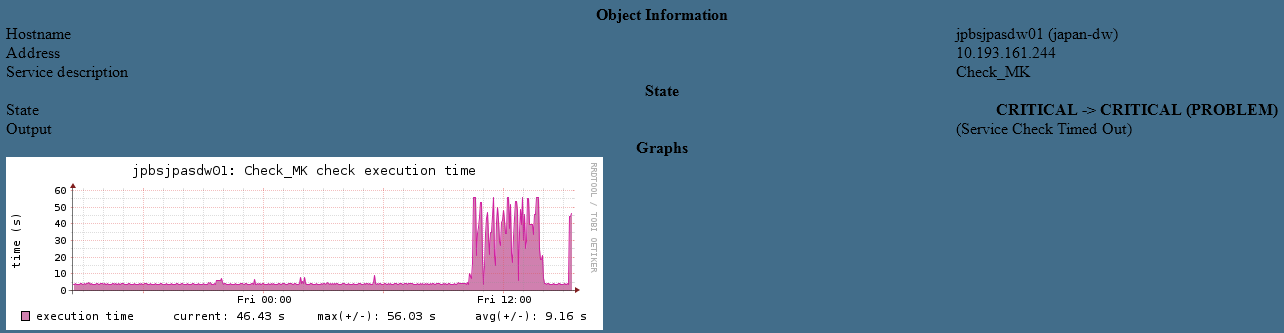
indicating the server was down or not contactable. The most likely cause was problems with the communications after all the server is on the other side of the globe. We decided to wait over the weekend and see if the communication is reestablished. And sure enough late that evening we got a reassuring mail telling all was well.

Since it was weekend and the replication process is self healing we didn’t have to do anything, if anything was wrong in the database it would be corrected the day after by the next replication cycle. That’s the way I like to build processes, no manual monitoring or intervention needed, computers should be able to fix operational problems themselves.
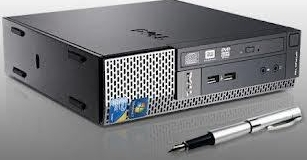
This satellite ‘server’ is a tiny Dell Optiplex 790 with an Intel I3 processor 4GB RAM and two 1TB SATA disks, costed less than 800€.
We installed the satellite server as temporary cache 2012 to overcome the slow communication line between the HQ and the Osaka plant. I figured if it lasts a year it would be good enough, (the network guys were just about to crank up the bandwidth). Now into the 4th year of continuous operation the computer is alive and kicking well, serving the factory guys with local response times for the cost of the electricity to run the computer. I have not seen similar features in any other Business Intelligence system. No matter how fast your high cost super duper central BI system is, you will not beat this tiny satellite at the remote branch office, noway.
Sometimes when I brag about the Data Warehouse, people tell me ‘Don’t be ridiculous you can’t be better than IBM, Oracle, SAP, Microsoft and the others’. It is very hard to prove I’m better than the competition, luckily for me, I do not need to do that, the Data Warehouse is there kicking ass with the competition. Normally I do not make a lot of fuss about myself, but sometimes it’s hard to be humble, I’m better than the big guys. That doesn’t mean I disrespect the others, far from it I have a lot of respect for what they have done, but someone has to be best, it’s simple as that. It’s not always about being smarter and having more resources, sometimes it is about having the simpler concept and execute it well.
Subscribe to:
Posts (Atom)