2016-02-27

Improving performance with covering index.

To appreciate this post you must read the post  when fast is not enough first.


I was asked some weeks ago, ‘can you explain your PHP structure assembling program?’.
Why? I asked.
‘It seems we have a problem, it takes about 10 hours to assemble the spare parts structure for the CPD factory!’


Ten hours is definitely too much, in this spare BOM tree there are some 8000 structures or bills of meterial and some +400000 tree nodes. I expected this to take some 15 minutes at the most.
Something must be awful wrong, so I decided to take a look myself first. Sure enough it was the tree assembling PHP program that took some 10 hours. It was setup to distribute the work over 7 parallel threads like this:

This was obviously just cut and pasted from a job with a much larger BOM where the chunks assigned to threads was optimized for that special BOM. As you can see from the forevery iterator, the first chunk takes the first 11000 bills or top nodes. In this example we only have 8000 BOMs to assemble, which means all go into the first chunk effectively single-threading the assembly job, in this case it would probably be better to split the BOMs evenly over 7 chunks like this:

  
Here we do not try to optimize each chunk, it will be good enough to split the BOMs evenly (on 7 chunks) and parallel process them all. Said and done, now we were down to about 1 hour 20 minutes, which was expected since we now run seven parallel threads, still this was not good enough, since I know the PHP program iterates the same SQL query for every node I took a look into PhpMyAdmin to see what’s going on:
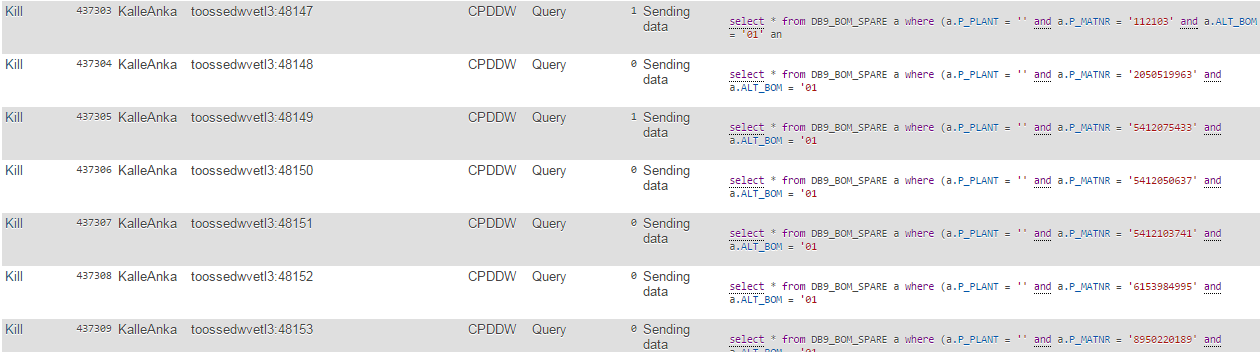
  
We run this query over and over again, and a close examine of the table we found an index missing. In this case you really want a covering index as this will drastically improve performance.  This is easily fixed:
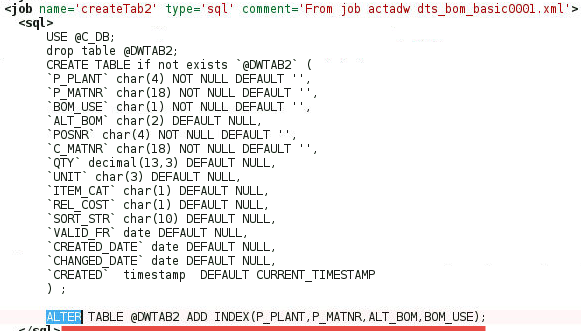

We just add an alter statement in the job creating the table.
(A covering index is an index that satisfies a query without accessing the table.)


And now we are down to about three minutes for the tree assembly job.

The moral of this post is: indexes are good, but optimizing too much is not necessarily good.

2016-02-26

Good Luck Camilla

This post is the hardest I will probably write in this blog, normally I do not have problems finding words but today I have. There are many thoughts but few words...

One year ago I wrote a post on the progress of the Data Warehouse. It was not a happy post since a highly esteemed member of BI development team left the company.
Today I have to write yet another sad post - Camilla leaves the company after some five years of brilliant work. Apart from being a brilliant Business Intelligence developer she took the lead and added much needed structure, good work processes, workflows and good will to The Data Warehouse.
She will be sorly missed by us all.

But the Data Warehouse must go on. When someone leaves some other have to step in.  This time it is Henrik that will carry on the good work together with newcomer Lucas.

Henrik scores on the football pitch.

I’m confident Henrik and Lucas together with the users will run the Data Warehouse successfully, and carry Camillas legacy forward.

2016-01-17

My Data Warehouse


20160117_135852.jpeg
Stockholm 2016-01-17
Recently I looked into some Data Warehouse systems. And I learned there is not anything on the market that compares with my Data Warehouse, I would not say my is better but it is very different from the others. Personally  I’m convinced my Data Warehouse concept is better, but that is what we all creators of Data Warehouses say I suppose.

Most Data Warehouse architectures are based on multidimensional cubes with a fact table in the middle. This model was conceived in the late seventies when the capabilities of the infrastructure were much weaker than today. Cubes have some intrinsic merits they give a logical structure to the data, have low redundancy and are economical with disk space. But there are disadvantages of cubes which outweighs the strengths. Cubes are hard to understand and decode. Very few non-specialists can extract data directly from cubes. Cubes are complex to maintain, and they are slow to access. I prefer simple two dimensional tables containing all data needed for a report. Tables are simple to understand and easily accessible from spreadsheets which are in every business user's toolbox. Data in my warehouse is organised in tables not in cubes.

Most data warehouses store data in relational databases which are accessed and manipulated via SQL statements. For some reason most Data Warehouse system goes to great lengths to conceal SQL from the Data Warehouse admins, instead they invent their own access language or extend a common programming language with their own access libraries. I created a workflow engine and scheduler which focus on executing jobs with a minimum of ‘macro code’, data manipulation is done directly by SQL. The entire ETL process is written in SQL, instead of an obscure language only insiders understand.

ETL processes of Data Warehouses often process very large amounts of data, parallel process workflows and split workflows into parallel ‘subflows’ is of paramount importance. My implementation of parallelism via piggyback iterators, is the simplest and most elegant parallel programing algorithm I’m aware of and it is a far cry from other traditional parallel programing idioms.

My Data Warehouse: Two dimensional tables, SQL and simple sound parallelism.

2016-01-05

Balanced parallel execution

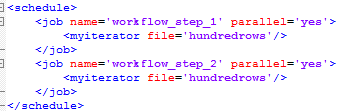
I have written some posts on the importance of parallel execution and how to program parallel  integration workflows with my Integration Tag Language. A workflow called a <schedule> often consists of a number of workflow steps called <job>.  Here is a ‘bare bone’ schedule with  2 jobs processing a file with 100 rows:
When this schedule executes these jobs execute one by one in sequence. If  the jobs are independent of each other it would be better to execute them in parallel, this is achieved by adding the parallel attribute to the jobs, like this:


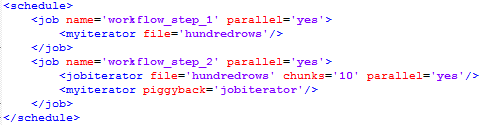
If job 1 takes 1 minute and job 2 takes 10 minutes then you have not gained much by parallel process the two jobs, the jobs are unbalanced from a parallelization view. If we break down job two into 10 parallel sub processes the 2 jobs are balanced. You do this by introduce a job iterator and piggyback connect the myiterator to the jobiterator, like this:
Here the jobiterator cuts the file into 10 pieces and parallel execute them all, each chunk is given to a myiterator. In theory the two jobs should now execute in 1 minute and this is what I refer to as parallel balanced workflow. The wall clock time is reduced by 82%, with very little effort.
In real life not many workflows behaves as nicely as this one, you may have to adjust the chunks a bit to achieve about equal execution time.

2015-12-31

Happy New Year

This was supposed to be a rather lengthy post, but zscaler was tired today, making me waiting for gateway.zscaler.net for to long, and now time is running out but...

Another year have past again. At work I didn’t accomplish at all what I had hoped for. But I have done some other things, like helping out with evaluating software and some integration problems. I did not do one line of JavaScript coding which I really had hoped to do, this is only partly due to lack of time I hadn’t any good projects for javaScript and I do not code just for the sake of coding. I didn’t buy a raspberry Pi same thing there I didn’t have a good project for a raspberry Pi. I didn’t try Perl6. There are a lot of things I didn’t do. But I tested the Amazon infrastructure learned a few thing about Azure cloud. I managed to create a travel expense report by myself, I never done that before so I’m happy for that.   
Two colleagues have left this year, that is never fun. A data warehouse specialist left and that was not only un-fun it was almost painful, I’m still emotionally attached to my old data warehouse and those who work there.
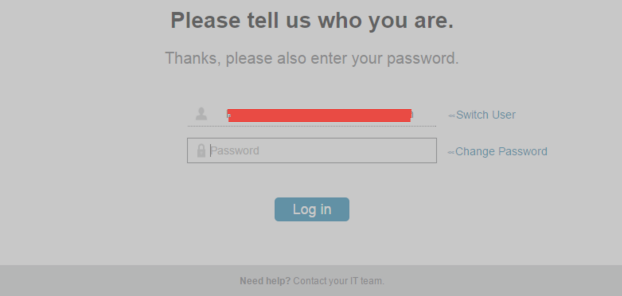
Actually the zscaler just went bananas, it blocked my internet access with this prompt
I would never type in a password in a frame like this. Need help contact your IT team, this is the 31 of december at 16:45 do not think anyone will answer.
Years end is the most IT-important day of the year, and you should make an extra effort to avoid anything that can interrupt or disrupt IT services this and next day of the year.

2015-12-06

Extracting SAP projects with BAPI - 3

I am restructuring some long running Data Warehouse extraction workflows. In total these workflows takes some 4 hours today, which is ridiculous. One part of restructuring the workflows is to use modern Integration Tag Language idioms, so newcomers  can understand, the present archaic syntax is a bit tricky. I have rewritten the second part in much the same way as the first.
So far I cut down execution time from 4 hours to 30 minutes. This is achieved by parallelizing the jobs running the BAPIs. I have rewritten the last parts of the workflow much in the same way I rewrote the first part.
The result is good, but not good enough Still the runtime is dependent on the amount of objects defined in SAP, in a few years when projects have doubled so will the runtime. I strongly advocate full load over delta load, since full load is much simpler to set up and is self healing if something goes wrong. But here is a case when full load is not performant enough, 30 minutes and growing by the day. I will rewrite these workflows from full load into a hybrid delta load where I aim at a more stable run time below 10 minutes.    

One job in the last rewrite is of interest: SAP information BAPIs are structured with one BAPI giving a list of keys to all objects and then you have an army of BAPIs giving detailed information about individual objects. BAPI_NETWORK_GETINFO is a bit different it takes an array of network identities and respond with detail info of all objects in one go, here the € list operator comes to the rescue, it  takes a PHP array and reformats it into a RFC import array.

The BAPI_NETWORK_GETINFO is run once for all networks in sequence.

  1. The <forevery> job iterator creates the iterator from the NWDRVR mysql table.
  2. Then runs the BAPI_NETWORK_GETINFO BAPI for each row in the SQL result table one by one. (Addressed by @J_DIR/driver1)
  3. Lastly stores all results in corresponding MYSQL tables   

If the list of network objects is large enough you have to spit the array into chunks and execute them separate to overcome SAP session limits and performance problems. We have some 9000 projects and that is to many in our environment to execute in one go.
A small rewrite of the job will split the SQL result into 8 chunks and distribute them over separate workers and execute the in parallel:

Here BAPI_NETWORK_GETINFO is run in 8 parallel workers.

  1. The <forevery> iterator splits the SQL result into 8 chunks, each chunk is executed by a separate worker in parallel
  2. Each worker then runs the BAPI_NETWORK_GETINFO BAPI for each row in the SQL result table of the worker one by one. (Addressed by @R_DIR/driver1)
  3. Lastly each worker store all results in corresponding MYSQL tables

With this slight modification the run time for the job is cut by a factor of 8. This is really parallel programing made easy. Compare this with visual workflow programing so popular today, I think you will agree with me this is easier to set up.

2015-11-29

What's in a return code?

The last week I have mused on ‘What’s in a return code and what it is good for’. It started with the innocent question:
‘How do I see which job in a workflow that bombed out’?
‘The first job with result equals zero’.
‘There is no zero result, there are only ones and nulls’.

My job scheduler return codes are boolean 1=success, 0=failure’. It is not entirely true, the return code can be NULL, which normally means not executed yet. I decided to take a look in the log:

The first job without a return code is trunc_dsaldo, up until trunc_dsaldo all jobs have executed successfully (result=1), it turned out trunc_dsaldo was successfully bypassed, the boolean return code does not really allow for a third ‘bypassed’ condition. The registration of a bypassed job is bypassed altogether so it is impossible to tell a bypassed job from a not executed job.  

I like boolean return codes.  Either a job executes successfully or not, it could not be more simple if it were not for the bypass condition. In this particular case it was the next job dsaldo_read who failed, due to an infrastructure fuckup the job failed and the connection to the database log table was lost, so it could not register a failure. A very unlikely situation, but nevertheless it happened.  

What is the a return code good for?
The most obvious reason the return code should tell the result of a job? In this case it does not do that well. You can argue the result of a bypassed job is unknown and should be left with a Null return code, but you can also say it was successfully bypassed and should qualify for a successful return code, but a bypassed job can be seen as a failure. Right now I lean towards giving bypassed a unique non zero return code but keeping the boolean type. This approach keeps the boolean simplicity but has a side effect it indicates the job was successfully bypassed. I still do not know if this is a good thing or not. I have to scrutinise some unnecessary complex code carefully before I make any changes. If I decide to change the code I will rewrite job related ‘return code’ code, since it has been subject for some patching during the years.
Another and maybe the most important function of a return code is testability, for successor jobs to test the outcome of a predecessor, that has already been taken care of, you can set up a job prereq testing the outcome of a predecessor job example:
<job name=’successor’...>
  <prereq type='job' predecessor='previousJob' result='success’ bypassed='ok'/>  
The successor job will run if the execution of previousJob was a success or previousJob was bypassed.
But the job return code has not got the attention it deserves, it’s a nice way to say there is some odd logic and bad code lurking in my job scheduler concerning return codes. Maybe return code should be a class. I’m not much of an OO fan, but return codes are important and maybe deserves a class of it’s own.